News
Why is Your Legacy UPS Failing the GPU Step-Load Test?
Is your data centre ready for a 30kW rack? As AI workloads saturate the UK grid in 2026, legacy power protection is no longer just inefficient; it’s a liability. Without a modern high-density UPS, "Step Loads" are crashing systems. It's now time to future-proof your facility.
As we move into the height of summer 2026, the UK data centre landscape has hit a fever pitch. While the solar trend of the beginning of the year focused on the noise created by renewable integration, July brings a much more aggressive challenge with the AI energy appetite.
With the UK Government’s new AI growth zones coming online and the July energy price cap adjustment squeezing margins, data centre operators are facing a dual crisis. It isn't just about the cost of electricity anymore; it’s about the dynamic nature of how AI consumes it.
If you are running hardware designed in 2022 to protect loads in 2026, you are likely standing on a fault line. The transition from traditional CPU-based enterprise computing to GPU-intensive AI clusters has fundamentally changed the physics of power protection, demanding the rapid response times only found in a high-density UPS.
The Step-Load Crisis
In a traditional data centre, power draw is relatively predictable. Servers ramp up as users log on, but the diversity of thousands of different tasks means the overall load curve is smooth.
However, the rise of AI has fundamentally shifted the requirements for modern Data Centre Power. AI workloads, whether training a Large Language Model (LLM) or running massive inference clusters, are synchronised. When a job starts, thousands of GPUs demand maximum power simultaneously. This puts an incredible strain on the three-phase UPS distribution, as the balance of the load shifts in an instant.
What is a Step Load?
A step load is a sudden, massive jump in power demand. In a microsecond, a rack can jump from an idle 2kW to a staggering 30kW or 50kW.
For a legacy three-phase UPS system, this is the equivalent of a car going from 0 to 100mph instantly. Most older Uninterruptible Power Supplies simply cannot react fast enough. They see this sudden surge as a fault or an overload.
The Symptoms of a Failing UPS
- Frequent Bypass Events: Your UPS constantly switches to Internal Bypass, meaning your critical AI hardware is running directly on dirty grid power with zero protection.
- Voltage Sags: The UPS dips during the step load, causing silent data corruption in GPU memory or crashing the training model entirely.
- Thermal Runaway in Batteries: Legacy VRLA (Lead-Acid) batteries struggle with the high-discharge rates required by AI spikes, leading to ballooning and premature failure in the heat.
- Incompatibility with Liquid Cooling: As AI forces a move to liquid cooling, the UPS must now handle the specific pump and compressor loads that standard air-cooled UPS units weren't designed for.
What You Can Do Right Now
Before calling in the engineers, every Data Centre Manager should perform a July Power Audit. Here is what you can assess yourself to see if you are at risk:
1. Check Your UPS Utilisation vs Peak
Don't look at your average load. Look at your transient load. Check your UPS logs for overload or bypass warnings that occur at the exact moment a new AI batch begins. If you are hitting 80% utilisation on a legacy unit, a 20% step load will trip your system.
2. Monitor the Ambient Oven
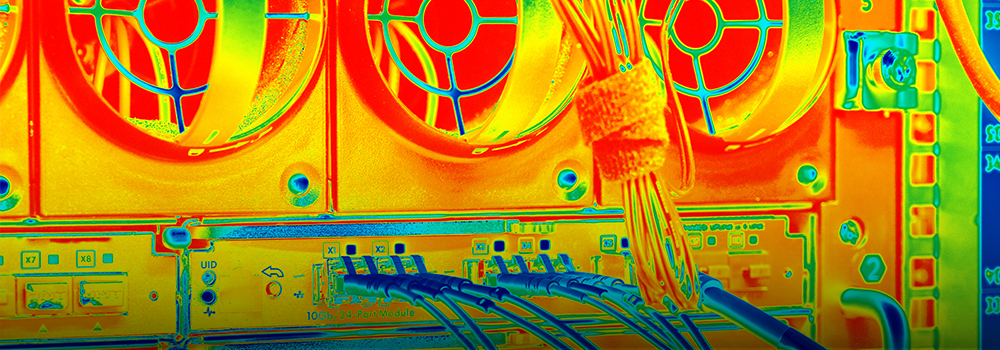
In the summer, server rooms become ovens. AI racks generate three to five times the heat of standard racks. Use a thermal camera to check the temperature of your UPS battery strings. If they are exceeding 25°C, you are halving their lifespan every single week.
3. Review Your Redundancy Logic
Is your N+1 architecture actually N+1 for peak loads? In many legacy setups, the redundant unit is only redundant for the average load. If one unit fails during an AI spike, the remaining units will instantly cascade into a total shutdown.
The Data Centre Solution
At Adept Power Solutions (APS) we engineer resilience. To solve the AI Power Gap, we focus on three specific technological pillars:
- Transitioning to Three-Phase Power (Riello & Eaton): For high-density AI, single-phase protection is a relic of the past. We steer our data centre clients toward industrial-grade Three-Phase UPS systems, such as the Riello Sentryum or the Eaton 93PM G2. These units are the gold standard for data centre power because they are designed for 100% Step-Load Acceptance. They can handle a 0-to-100% load jump without dropping out of Double Conversion mode. They provide a total "electronic air gap" between the volatile grid and your sensitive GPUs.
- The Lithium-Ion (Li-ion) Advantage: In the high-heat, high-spike environment of an AI data centre, lead-acid batteries are the weak link. Adept Power is a leader in UPS Lithium-Ion retrofitting. Li-ion batteries handle deep, rapid discharges much better than VRLA. They also operate safely at higher temperatures (up to 40°C), reducing your July cooling costs significantly.
- Modular Pay-as-you-AI Scalability: Building for 500kW today when you only need 100kW is a waste of CapEx. We specialise in Modular UPS Architectures. To maintain reliable data centre power, start with a 100kW frame and add 20kW power modules as your AI cluster grows. If a module fails, it is hot-swappable, meaning we can fix it while your AI training stays online. No downtime, no risk.
Partner with Adept Power
The UK market is flooded with resellers who ship a box and disappear. Adept Power is different because we are Service-First. Our 24/7 operations centre sees your UPS health before you do. We track battery impedance and internal temperatures in real-time, catching hot cells before they cause a fire or a failure.
We manufacture our own external maintenance bypass switches in-house. This allows you to isolate your entire UPS system for maintenance without ever powering down your AI racks. We don't guess. Our engineers use high-speed power quality analysers to map your step load profile, ensuring the UPS we specify is the UPS you need.
The AI revolution is the greatest opportunity for UK data centres in a generation, but it is also the greatest stress test for infrastructure. If your UPS is beeping, if your cooling bills are skyrocketing, or if you are worried your current system won't survive the next AI workload spike, it’s time to talk to a specialist. Contact Adept Power Solutions today for a High-Density Power Audit.
Related Articles